
|
Leading Change Effectively
Why do people often resist change? How does change affect
people? What actions can change leaders take to help people through resistance
and into commitment to help realize the benefits of a change?
The Emotional Journey.
Based upon our research - and the research of others - it's clear
that when change is introduced in an organization there is a natural and
inevitable emotional path that people follow. We call this the emotional
journey through change. This journey begins when a change challenges people
with ideas or approaches that conflict with what they know and with which
they are comfortable. In the face of this challenge, people often react
in ways that seem to undercut the change. If, however, we work to better
understand the emotional journey people take in response to a change,
we are more likely to find success in developing employee commitment to
a new direction.
A Powerful Model.
In our book Leading Change Training (published by ASTD Press, April 2003),
we introduce a powerful approach for understanding the human response
to change and, most importantly, helping to lead people through change.
In this book, we propose a four-phase model that helps explain the common
emotional reactions people experience - and that offers a framework for
helping leaders successfully guide people through the change process.
Phase One - Comfort & Control. In this first phase of the emotional
journey, people feel comfortable, safe, and in control of their lives.
There is order in their environment. They understand where they fit in
and what's expected of them. While they may even be dissatisfied with
the status quo, it is at least familiar to them; they have found a way
to deal with the stresses of the world as it is. In this phase, the greatest
challenge for the leader is simply to get people to wake up! That's why
the actions called for in this stage involve creating a felt need for
change.
Phase Two - Fear, Anger, &
Resistance. Once people are nudged (or pushed) out of Comfort
and Control they are immediately plunged into the next phase: Fear, Anger,
and Resistance. In this phase people feel anxious and uncertain ? as well
as angry and fearful ? because what they knew to be true about the organization
and their role within it is being set aside. They have been told that
the ways of the past and present are no longer adequate for the challenges
of the future. Suddenly, the world is a more insecure and uncertain place.
Leaders' actions for this phase involve listening to the fears and anxieties
and attempting to respond to these concerns - while continuing to move
forward with the change.
Phase Three - Inquiry, Experimentation,
& Discovery. As people's anxieties, fears, and perceived
losses are listened to and addressed in the change process, and as they
begin to take part in designing the change itself, they transition from
focusing on the past to focusing on the future. Once people (consciously
or unconsciously) cross the threshold from "looking back" to
"looking forward," they begin to work with the change, to shape
it around their own needs and issues as well as those of the organization.
By engaging in inquiry (asking questions), experimentation (trying out
new ideas), and discovery, those in this phase begin to "connect
the dots" and help create a new reality. Despite the positive focus
of this phase, however, this can still be a frustrating time - since there
are still many unanswered questions. Leaders can help best by giving people
direction - but not so much that it stifles their creativity and their
own voice in designing the change.
Phase Four - Learning, Acceptance,
& Commitment. In this phase people begin to see that the
change ? which has been tested, shaped, and molded by their own actions
and the actions of others ? is beginning to lead to tangible and positive
results. They continue their search for answers to the challenges posed
by the forces of change and the change itself as they enter this phase.
And the solutions they discover become integrated into their thinking
and behavior. This learning, sparked by the chaos and confusion of the
change process and the need to restore direction and stability, is the
first sign of a real emotional commitment to the change. For the first
time, people who may have initially resisted the proposed change begin
realizing the promised opportunities and benefits.
Learn More About Leading Change
from RCI. Russell Consulting can help you lead your employees
through the change process. Contact us to purchase a copy of our book,
Leading Change Training, or for a free consult on how we can help you
lead change in your organization.
You can also view an outline of our book: Leading Change
Training.
Back to
Top
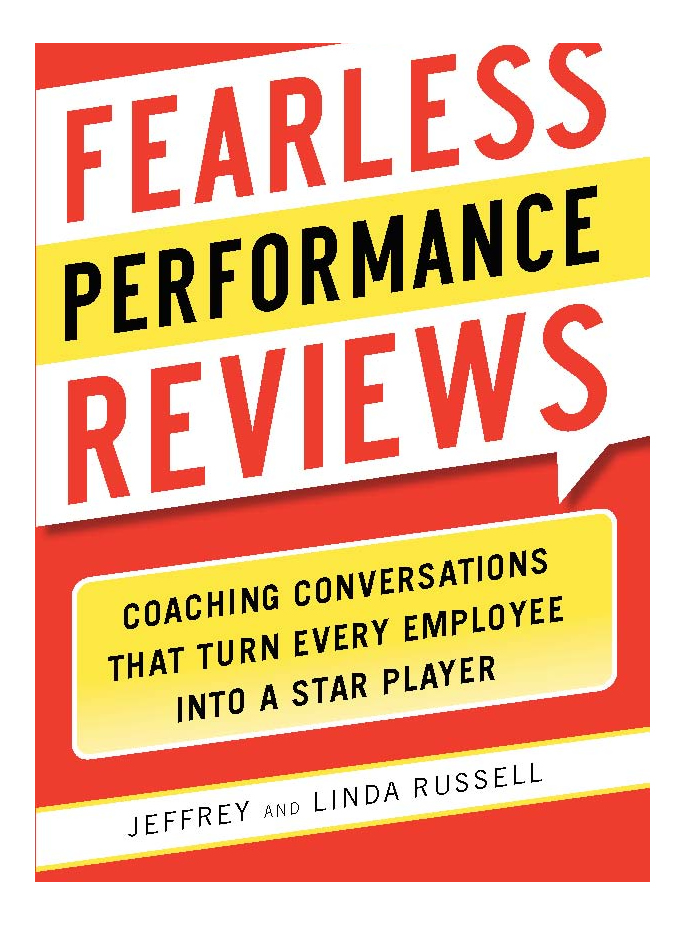
An Employee-Centered Performance Review
Most of us don't look forward to the annual performance
review. Whether we are the one doing the reviewing (the supervisor) or
the person being reviewed (the performer), too often the process is more
frustrating and anxiety provoking than satisfying and productive. There
is, however, a way out of the frustration and toward a more productive
result.
Sources of Distortion. The
quality of the performance review is affected by a host of issues that
distort the communication and understanding that takes place during the
review. These distortions include (a) the relationship between the reviewer
and the reviewed; (b) the reviewer's level of knowledge of the performer's
work; (c) the "recency" of the performance events and the feedback
(reviewers tend to recall more recent events vs. more distant ones); (d)
the "halo" effect - where the reviewer's perspective of the
performer is influenced by one attribute (e.g., great at landing the deal)
such that other performance issues (e.g., not getting along with co-workers)
are ignored; and (e) restrictions in the rating scale - where the reviewer,
wanting to avoid negative reactions from the performer in giving a "low"
score and not wanting to defend a "high" score, rates in a rather
narrow band that fails to distinguish between performers.
Consequences of Failure are High.
Many of these sources of distortion work to prevent a rater or reviewer
from conducting an effective performance review. And, when so much hangs
on the quality and effectiveness of this review, the consequences for
failure are high. Is there a way to reduce the impact of these sources
of distortion? And, just as importantly, is there a performance review
process that also reduces the performer's defensiveness and denial in
the face of constructive feedback?
Putting the Employee
In Charge & Improving the Process
RCI has developed a review process that reduces the sources
of distortion while increasing employee ownership of performance improvement.
This model, based upon the assumption that employees are best able to
assess their own performance, puts them in charge of the process. While
the supervisor stays engaged throughout - asking questions, guiding the
conversation, reinforcing the employee's perspective, challenging the
employee's self-perception when necessary, and exploring solutions - the
final responsibility for assessment and performance improvement lies with
the performer.
A further problem with the traditional review is that
we often try to do too much: give feedback, set improvement goals, rate
the performance, and link performance with pay. While these objectives
are laudable, RCI recommends that these elements be addressed at different
times in a multi-stage process. Here are the core principles that guide
our employee-centered performance review model:
The conversation is more important
than the rating. The primary purpose of the review is to engage
the performer in a conversation about what is and isn't working. While
the rating is important, what is more critical is getting the performer
to reflect on past performance and to guide him or her toward a higher
level. Equally important is the supervisor learning from the performer
about performance obstacles and what the performer needs from the system
to be most effective in his or her job.
The employee is in charge of
the process. As long as supervisors do the evaluating, employees
are able to take a back seat to managing their own performance. Asking
performers to take the lead in assessing their own performance, identifying
the causes of performance problems, and developing an improvement plan
puts responsibility for performance improvement where it belongs: on the
shoulders of the performer.
The supervisor/coach guides the
process. While employees must be in charge of their own performance
review, the supervisor never walks away from his or her responsibility
for shaping the employee's performance - and from giving specific feedback
on what the employee is doing well and where he or she needs to improve.
The role of the coach in this new process is one of asking questions,
listening, challenging, and guiding the employee's exploration of possible
solutions to performance problems.
Frequency of the review is jointly
determined. How often should the review occur? As often as
necessary - and "necessary" is jointly determined by the supervisor
and employee deciding on the best frequency to ensure continued great
performance.
The overall "rating"
by the supervisor and pay adjustments follow the conversation.
Finally, while developing an overall "rating" on a scale and
linking this rating to pay may be necessary (based upon your HR policies),
the best review process keeps this step removed by at least a day from
the performance conversation. There's nothing like getting a "3"
on a six-point scale to distract the performer from a serious exploration
of performance issues and the causes performance breakdowns.
Need Help to Develop
an Employee-Centered Review Process?
Contact RCI to find out more about our approach to performance
reviews. We can help you strengthen your performance review process and
enable you to achieve your goals - for individual performers as well as
your company.
Back to
Top
Read RCI's White Papers on Key Issues
So much of our work these days involves multiple players
doing complex tasks simultaneously to accomplish outcomes that have never
before been created. All of this complexity and interdependence calls
for an integrated approach for accomplishing work. The relatively new
discipline of "project management" provides a helpful roadmap
to those who want to manage their work while maintaining a high level
of control over quality results, project costs, and the schedule/due dates.
The fundamentals of project management involve first embracing project
management as a thoughtful step-by-step process for integrating the interdependent
pieces of a complex set of tasks and then closely monitoring that process
in the implementation of a project. There are four phases of project management:
Phase One - Project Conception:
The first phase of a project involves more thinking than work. In this
phase you define your scope, quality requirements, timeline, the boundaries
and parameters that you must attend to, and the talent/resources that
are available to move the project ahead. This phase requires adherence
to the admonition "don't just do something, sit there!"
Phase Two - Plan Development:
The second phase of project management involves detailing both the specifics
of your end results and the step-by-step process you'll use to accomplish
these results. Establishing key project milestones, assessing risks, identifying
deliverable dates, finalizing your costs, and noting the critical interdependencies
of tasks are critical steps of this phase.
Phase Three - Implementation:
The project kicks into high gear with this phase. Here your focus is now
on keeping the project on track as you manage the scope, schedule, and
costs. Monitoring these "triple constraints" gives you timely
feedback and enables you to make adjustments along the way.
Phase Four - Close-Out/Evaluation:
As you achieve your goals and your efforts on the project wind down, the
last project management phase leads you through a critical assessment
of what about the project worked and what didn't. Unfortunately, we often
set aside this phase and move on to the next project. The price we pay,
however, for not reflecting upon our project's successes, problems, and
challenges is that we fail to learn and improve - and we end up making
the same mistakes on subsequent projects.
Managing projects well is a key talent in today's lean
organizations. If you want to learn how to guide your company's projects
toward successful outcomes, contact RCI. We can help you develop the project
management competencies you need for success. Call us at 608.274.4482
or send us an e-mail.
Back to
Top
|